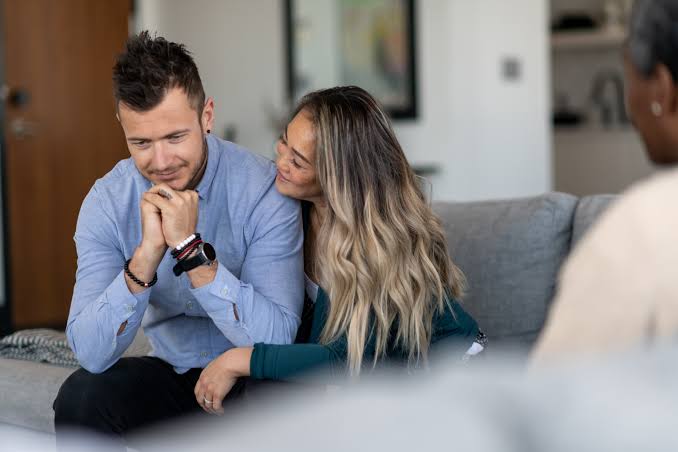
If you have booked a first session and you are quietly bracing for it, here is what to expect from couples therapy in Toronto: the early weeks often feel harder than the state you walked in with.
That is not a sign the therapy is failing. It usually means the work has started. Distress tends to rise before it settles, because the patterns keeping you stuck have to surface before either of you can change them.
Most couples do not come in early. Gottman Institute research puts the average delay at roughly six years of unhappiness before a couple asks for help. By then the arguments have a groove worn into them, and resentment has had years to set.
So the first job of therapy is not to smooth things over on day one. It is to slow the argument down enough that you can both see it, and that can feel worse before it feels better.
Why does couples therapy feel hard at the beginning?
Couples therapy feels hard at the beginning because it interrupts a loop the two of you have run for years. Every distressed relationship has one.
One partner pushes for connection or answers, the other pulls back to lower the heat, and each move sets off the next. Sue Johnson, who developed Emotionally Focused Therapy, named this the “dance.” John Gottman’s lab documented the same thing as the demand-withdraw pattern and found that couples stuck in it early carry a much higher risk of separation.
When a therapist names that loop out loud, it can sting. You came in hoping your partner would change, and instead you are both being asked to look at a cycle you share.
Part of what makes the start hard is that many couples arrive convinced things are just a rough patch. Waiting for the promotion, the kids getting older, or the season to pass is a way of hoping the problem sorts itself out. Therapy takes that hope off the table and asks you to work instead, which is uncomfortable and also the point.
What happens in couples therapy in the first few sessions?
What happens in couples therapy at the start is mostly assessment, not fixing. A good therapist spends the first two or three sessions mapping how you fight, what each of you is protecting, and what sits underneath the surface complaint.
Expect questions about your history together, your families, and the times the relationship actually felt safe. Some therapists also meet with each partner alone once, to hear things that are hard to say in the same room.
You will likely be asked to talk to each other during the session, not only to the therapist. That can feel exposing, and it is meant to.
The therapist needs to watch the real pattern play out, not the tidied-up version either of you would narrate solo. Sessions usually run 50 to 90 minutes, and many Toronto therapists book a longer first appointment to get through this groundwork before any real change work begins.
Is it normal to feel worse after starting couples therapy?
Yes, feeling worse for a stretch after starting couples therapy is common and often expected. Once honest things get said, the conversations you had both learned to avoid come back into the open.
Feelings held down for years can surface fast. One partner may feel flooded by emotion they have been sitting on; the other may feel blindsided by the intensity of what comes up.
Clinicians tend to call this productive discomfort. The cliché fits here: you clean a wound before it can close.
The research backs the payoff. A 2022 meta-analysis of Emotionally Focused Therapy, pooling 20 studies, found that roughly 70 per cent of couples moved from distress to recovery by the end of treatment, with gains holding up at the two-year mark. The rough patch early on is part of how couples reach that, not evidence against it.
How do you tell productive discomfort from a bad fit?
Productive discomfort and a bad fit feel different, and learning to tell them apart matters. Discomfort that is doing its job leaves you raw but also more aware.
You can name feelings you could not name before. The hard things that come up feel relevant, even when they hurt. You feel tired after a session rather than hopeless, and you feel understood by the therapist even on the difficult days.
A poor fit or an unsafe process feels different. Some warning signs worth taking seriously: only one partner is consistently blamed or pathologized, sessions leave you feeling invalidated week after week, you feel less safe rather than more, or the strain drags on for weeks with no shift and no talk of adjusting the approach.
Couples therapy is also not the right container when there is ongoing abuse in the relationship; that situation needs a different kind of help first. If any of this matches your experience, say so directly in session, and take seriously the question of whether this therapist is the right one for you.
What can you do to make the hard start easier?
The single most useful thing you can do is treat couples therapy as something that happens between sessions, not only inside them. A large share of the change lands at home, in the small moments when you catch the old pattern and choose differently.
Couples who practise what they work on, slowing a fight down, naming a feeling instead of firing an accusation, tend to move faster than couples who only show up on Tuesday.
A few things help in the early weeks. Give yourself time to come down after a heavy session instead of restarting the argument in the car. Go in with a shared goal you can both name, even a modest one.
And resist judging the whole process by how you feel walking out of a single session. Look at the pattern over a month. Shorter fights and quicker repair are the early wins, and they are easy to miss if you are waiting for one big breakthrough.
How long before couples therapy starts to feel better?
Most couples notice a shift within a few weeks to a couple of months, though there is no fixed timeline and yours may differ. The early phase of surfacing and de-escalating is usually the hardest stretch.
Relief tends to arrive as the new skills start to feel less clumsy: fights that end sooner, repair that comes faster, more honesty without the blow-up.
What matters is not whether you still argue. Every couple argues. It is whether you can find your way back to each other afterward, and whether the distance between you is shrinking over time rather than growing.
How do you find couples counselling near you in Toronto?
Finding good couples counselling near you in Toronto comes down to fit, credentials, and format. In Ontario, psychotherapy is a regulated act, so check that your therapist is registered with the College of Psychologists and Behavior Analysts of Ontario or College of Registered Psychotherapists of Ontario or another recognized health college.
Ask whether they are trained specifically in couples work, ideally in EFT or the Gottman Method, because working with two people at once is a distinct skill from individual therapy.
Format is worth a thought as well. Virtual couples counselling is now standard across the Greater Toronto Area, and the evidence is reassuring: recent research finds video sessions about as effective as in-person for relationship satisfaction, though the working bond tends to build a little faster face to face.
For a lot of couples, not having to sync two commutes after work outweighs that gap. Either way, OHIP does not cover private couples therapy, though many extended health and workplace benefit plans do.
If you take one thing from all this, take this: the hard start is not the problem to solve. It is often the first honest thing your relationship has done in a long time.